
Medical Disclaimer: This content is for informational and educational purposes only and is not a substitute for professional medical or nutritional advice. Always consult your child’s pediatrician or a qualified healthcare professional regarding individual health or dietary needs.
Finding nutritious foods your child will actually eat can already feel like a challenge. Add terms like “inflammation,” “omega-3s,” “antioxidants,” and “gut health” to the conversation, and feeding your family can suddenly feel much more complicated than it needs to be.
The good news? Anti inflammatory foods for kids don’t need to be unusual, expensive, or difficult to prepare.
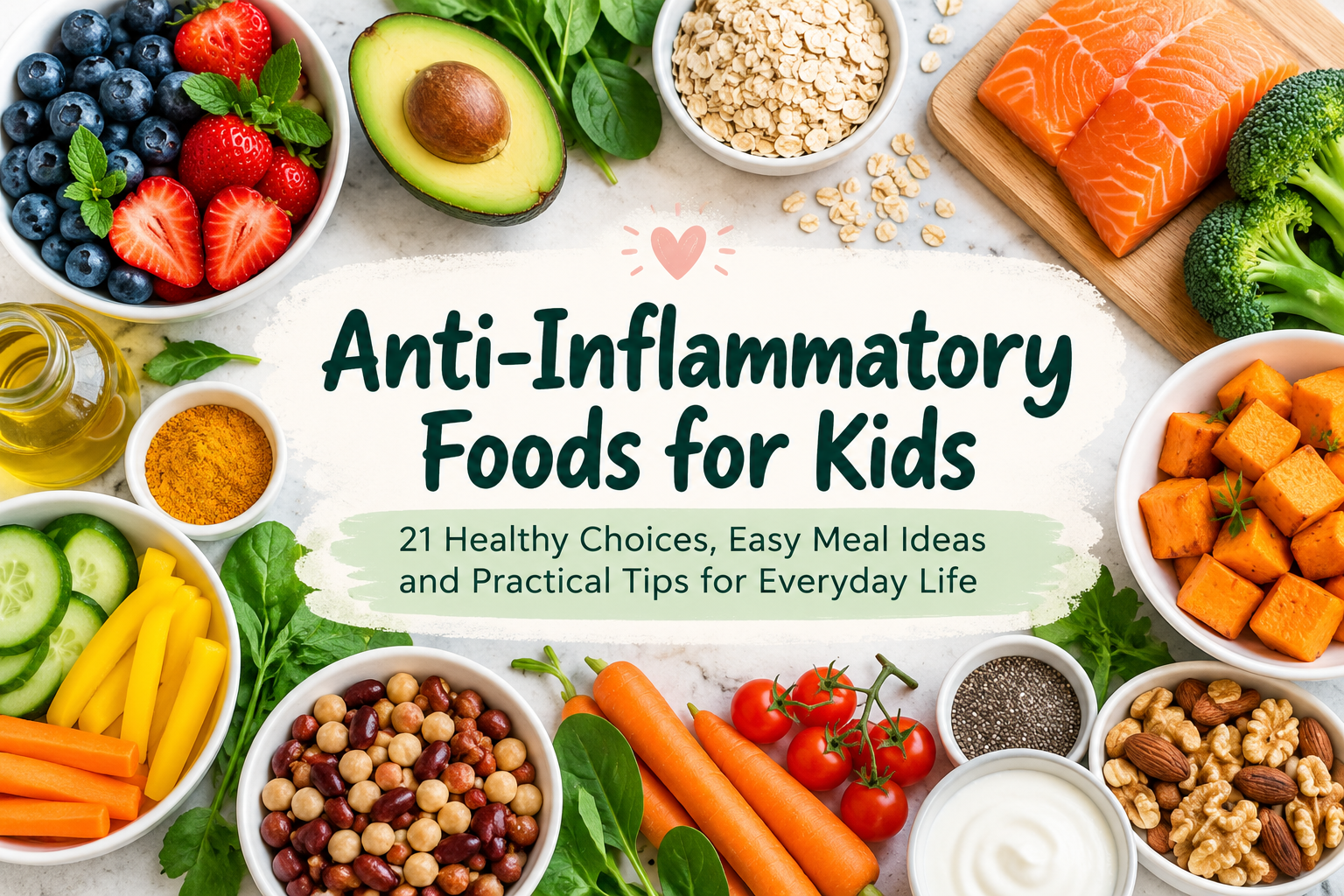
Many familiar foods—including berries, oats, avocado, beans, vegetables, olive oil, and salmon—fit naturally into an eating pattern that emphasizes fruits, vegetables, whole grains, legumes, healthy fats, and nutritious protein sources.
And there is another important point parents should know: inflammation itself isn’t automatically bad. Acute inflammation is a normal part of the immune system’s response to injury, infection, and other threats. The concern is persistent, chronic inflammation. There also isn’t one officially defined “anti-inflammatory diet” that every child should follow.
Instead of trying to create a restrictive diet, a more practical approach is to focus on variety, minimally processed foods, fiber-rich plant foods, healthy fats, and balanced meals.
Below you’ll find 21 kid-friendly foods, easy ways to serve them, simple food swaps, a one-day meal example, and tips for introducing these foods to picky eaters.
Important: This article is for general educational purposes and is not medical advice. Children with food allergies, medical conditions, growth concerns, digestive problems, or special dietary needs should receive individualized guidance from their pediatrician or a qualified registered dietitian.
What Are Anti Inflammatory Foods for Kids?
There isn’t a single food that can magically “fight inflammation,” and no individual ingredient should be expected to prevent or treat a health condition.
When people talk about anti-inflammatory eating, they are generally referring to an overall eating pattern rich in foods such as:
- fruits and vegetables
- whole grains
- beans and lentils
- nuts and seeds
- unsaturated fats
- omega-3-rich foods
- minimally processed foods

Research on anti-inflammatory dietary patterns often highlights foods that provide fiber, phytochemicals, antioxidants, and unsaturated fats. Mediterranean-style eating patterns, for example, share many of these characteristics.
For children, however, the goal shouldn’t be to put them on a restrictive “diet.” Kids need enough energy and a wide range of nutrients to support growth and development.
Think addition before restriction.
What colorful fruit could you add to breakfast? Could you add avocado to a sandwich? Could oatmeal occasionally replace a highly sweetened breakfast? Could your child discover one new vegetable they enjoy?
Small changes like these can make balanced eating much more realistic for the entire family.
21 Anti Inflammatory Foods for Kids
Here are 21 nutritious foods that can fit into a family-friendly eating pattern.
1. Blueberries
Small, naturally sweet, and easy to add to meals, blueberries are one of the simplest fruits to introduce to many children.
They contain fiber and naturally occurring plant compounds called polyphenols.
Kid-friendly idea: Add blueberries to oatmeal, plain yogurt, pancakes, or a smoothie.
Frozen blueberries can also be a convenient option when fresh berries are expensive or out of season.
2. Strawberries
Strawberries provide vitamin C, fiber, and a variety of plant compounds.
Their natural sweetness also makes them useful when transitioning from heavily sweetened snacks toward more fruit-based options.
Kid-friendly idea: Slice strawberries over oatmeal or yogurt, blend them into a smoothie, or serve them alongside breakfast.
For younger children, prepare berries in an age-appropriate way to reduce choking risk.
3. Apples
Apples are affordable, widely available, and easy to pack in a lunchbox.
They provide fiber and various plant compounds, especially when the peel is eaten.
Kid-friendly idea: Try thinly sliced apple with an age-appropriate spread of peanut or seed butter, grated apple mixed into oatmeal, or baked apple with cinnamon.
4. Oranges
Oranges and other citrus fruits provide vitamin C and make an easy naturally sweet snack.
Choosing whole fruit rather than relying on juice also provides fiber.
Kid-friendly idea: Serve peeled orange segments with breakfast or alongside a snack.
5. Avocado
Avocado provides primarily unsaturated fat along with fiber and several vitamins and minerals.
Its creamy texture makes it especially versatile for family meals.
Kid-friendly idea: Mash avocado onto whole-grain toast, add it to a wrap, make simple guacamole, or serve slices alongside eggs.
6. Broccoli
Broccoli provides fiber, vitamin C, vitamin K, folate, and numerous plant compounds.
If steamed broccoli gets rejected, don’t assume your child dislikes broccoli entirely. Preparation can make a huge difference.
Kid-friendly idea: Try roasting small broccoli florets with olive oil until the edges become slightly crispy.
A familiar dip can also make vegetables feel less intimidating.
7. Spinach
Leafy greens such as spinach provide several vitamins, minerals, fiber, and plant compounds.
You don’t need to convince your child to eat a giant spinach salad to include it in their diet.
Kid-friendly idea: Add a small amount of chopped spinach to scrambled eggs, pasta sauce, quesadillas, soup, or a fruit smoothie.
The goal isn’t to “hide” vegetables forever. It’s to offer them in different forms and help children become familiar with them.
8. Sweet Potatoes
Sweet potatoes provide fiber, potassium, carotenoids, and other nutrients.
Their naturally sweet flavor can make them an easier vegetable for some children to accept.
Kid-friendly idea: Make oven-baked sweet potato wedges with olive oil, mash them as a side dish, or add roasted cubes to a grain bowl.
9. Tomatoes
Tomatoes contain vitamin C, potassium, and the carotenoid lycopene.
They’re also incredibly versatile.
Kid-friendly idea: Try cherry tomatoes prepared safely for your child’s age, homemade tomato sauce, tomato soup, or chopped tomatoes in a quesadilla.
10. Carrots
Carrots are rich in carotenoids, including beta-carotene, which the body can convert into vitamin A.
They can be served cooked or raw depending on the child’s age and chewing ability.
Kid-friendly idea: Roast carrots with olive oil until naturally sweet and soft, grate them into muffins or oatmeal, or serve appropriately prepared carrots with hummus.
11. Oats
Oats are an easy whole grain to keep in the pantry. They provide fiber, including beta-glucan.
They also create a blank canvas for other nutritious foods.
Kid-friendly idea: Make oatmeal with berries, cinnamon, yogurt, chia seeds, or a small amount of nut or seed butter.
Overnight oats can be another quick option for busy mornings.
12. Brown Rice
Brown rice is a whole grain that provides fiber along with several vitamins and minerals.
That doesn’t mean white rice has to disappear from your kitchen. Family nutrition doesn’t need to operate on all-or-nothing rules.
Kid-friendly idea: Create a simple rice bowl with brown rice, chicken or beans, avocado, corn, and vegetables your child already likes.
13. Quinoa
Quinoa is technically a seed but is commonly prepared like a grain. It provides fiber and protein and can help add variety to family meals.
Some children dislike its texture at first, so mixing it with a familiar grain can help.
Kid-friendly idea: Start with half rice and half quinoa rather than serving a large bowl of quinoa on its own.
14. Beans
Black beans, kidney beans, chickpeas, and other beans provide fiber, plant protein, minerals, and other beneficial nutrients.
They’re also inexpensive and easy to keep in the pantry.
Kid-friendly idea: Add black beans to quesadillas, mash beans into a wrap, serve hummus with vegetables, or add beans to tacos.
Rinsing canned beans is an easy way to remove some of the sodium in the packing liquid.
15. Lentils
Lentils are another fiber-rich plant protein and provide nutrients including iron and folate.
Their soft texture makes them easy to incorporate into many meals.
Kid-friendly idea: Add red lentils to tomato sauce or soup, make mild lentil tacos, or mix cooked lentils into ground meat dishes.
16. Salmon
Salmon provides protein and long-chain omega-3 fatty acids along with several vitamins and minerals.
Fish deserves a little extra attention when feeding children because mercury levels vary by species.
FDA and EPA guidance recommends that children eat fish from lower-mercury “Best Choices.” Salmon is included among those choices. Portion sizes vary by age.
Kid-friendly idea: Try baked salmon bites, salmon mixed into pasta, salmon cakes, or a simple rice bowl.
If your child doesn’t like salmon immediately, keep portions small and continue offering different preparations without pressure.
17. Eggs
Eggs are an accessible source of protein and provide nutrients including choline.
They are also incredibly practical for busy families.
Kid-friendly idea: Try scrambled eggs with whole-grain toast and berries, mini vegetable omelets, or sliced hard-boiled egg in a lunchbox.
If your child has an egg allergy or suspected allergy, follow guidance from their healthcare professional.
18. Plain Yogurt
Yogurt provides protein and calcium, and varieties containing live cultures can provide beneficial microorganisms.
Plain yogurt also allows parents to control how much sweetness is added rather than relying entirely on heavily sweetened varieties.
Kid-friendly idea: Mix plain yogurt with mashed berries, sliced banana, cinnamon, or a small spoonful of nut or seed butter.
19. Walnuts
Walnuts provide unsaturated fats, fiber, plant protein, and alpha-linolenic acid (ALA), a plant-based omega-3 fatty acid.
Safety matters: Whole nuts can be a choking hazard for young children.
Kid-friendly idea: Depending on your child’s age, use finely ground walnuts or smooth walnut butter rather than whole nuts.
Families dealing with nut allergies should use an appropriate alternative recommended for their child.
20. Chia Seeds
Chia seeds provide fiber and plant-based omega-3 fat.
A small amount can easily be incorporated into foods your child already eats.
Kid-friendly idea: Mix chia seeds into oatmeal, yogurt, smoothies, or an age-appropriate chia pudding.
There’s no need to add huge quantities. More is not automatically better.
21. Extra Virgin Olive Oil
Olive oil is a staple of Mediterranean-style eating patterns and is rich in monounsaturated fat.
It can be an easy way to prepare vegetables and other foods without dramatically changing what your family eats.
Kid-friendly idea: Use olive oil to roast vegetables, drizzle it lightly over pasta, or use it in homemade salad dressing.
How to Build a Balanced, Anti-Inflammatory-Inspired Meal for Kids
Knowing which foods to buy is one thing. Turning them into a dinner your child will eat at 6 p.m. on a Tuesday is another.
Keep it simple.
A practical family meal can include:
1. A fruit or vegetable
Try berries, broccoli, carrots, tomatoes, avocado, oranges, spinach, or whatever produce your family enjoys.
2. A whole-grain or other carbohydrate source
Oats, brown rice, quinoa, whole-grain bread, potatoes, or sweet potatoes can all work.
3. A protein source
Examples include eggs, beans, lentils, yogurt, chicken, tofu, or lower-mercury fish.
4. A source of healthy fat
Try avocado, olive oil, seeds, or age-appropriate nuts or nut butter.
Not every meal needs to be nutritionally “perfect.” What children eat across days and weeks matters more than making every plate look like a nutrition textbook.
7 Easy Food Swaps for Families
Improving the overall quality of your family’s diet doesn’t require throwing everything out of your pantry.
Try small changes that feel realistic.
1. Sweetened breakfast cereal → Oatmeal with berries
Oatmeal provides whole-grain fiber, while berries add natural sweetness and colorful plant compounds.

2. White bread → Whole-grain bread
When your child accepts it, whole-grain bread is an easy way to add more fiber.
You can also transition gradually instead of making an overnight switch.
3. Sweet dessert-style yogurt → Plain yogurt with fruit
Berries or banana can provide sweetness while allowing you to control the amount of added sugar.
4. Cookies every snack time → Fruit plus a satisfying partner
Try apple with an age-appropriate nut or seed butter, berries with yogurt, or fruit with cheese.
This doesn’t mean cookies are “bad.” It simply creates more variety across the week.
5. Processed meat every day → Rotate protein sources
Try beans, eggs, chicken, lentils, tofu, or lower-mercury fish on different days.
6. Sugary drinks → Water with meals
Water can be the everyday default without labeling other drinks as forbidden.

7. Fried vegetable sides → Roasted vegetables with olive oil
Roasting can create a sweeter flavor and crispier texture that some children prefer over steamed vegetables.
A Simple One-Day Meal Example
Here’s what these ideas could look like during an ordinary day.
Breakfast
Berry oatmeal bowl
Cook oats with milk or an appropriate alternative. Top with blueberries or strawberries, plain yogurt, and a small amount of chia seeds.
Morning Snack
Apple and yogurt
Serve apple prepared appropriately for your child’s age alongside plain yogurt.
Lunch
Chicken avocado wrap
Use a whole-grain tortilla with chicken, mashed avocado, and a vegetable your child already accepts.
Serve orange slices on the side.
Afternoon Snack
Berry yogurt cup
Mix plain yogurt with mashed strawberries or blueberries.
For older children who can safely eat them, add finely chopped walnuts if appropriate.
Dinner
Salmon, sweet potato and broccoli
Serve baked salmon with roasted sweet potato and broccoli prepared with olive oil.
If salmon is unfamiliar, place a small portion next to a food your child already likes rather than expecting them to finish a full serving.
This example is meant for inspiration—not as a prescribed meal plan. Children have different calorie and nutrient needs depending on age, growth, activity level, medical history, and other factors.
What About Fish for Children?
Because salmon appears on this list, it’s worth understanding the official U.S. guidance.
Fish provides protein, fatty acids, vitamins, and minerals, but some fish contain more mercury than others.
The FDA and EPA recommend choosing a variety of fish from their “Best Choices” category for children.
Their general guidance is two servings per week, with serving size based on age:
- Ages 1–3: about 1 ounce per serving
- Ages 4–7: about 2 ounces per serving
- Ages 8–10: about 3 ounces per serving
- Age 11 and older: about 4 ounces per serving
Salmon is among the lower-mercury options included in the FDA’s Best Choices guidance.
Parents should consult the current FDA/EPA fish advice when selecting fish, particularly because mercury levels differ among species.
Foods to Limit Without Creating Food Fear
One problem with online discussions about inflammation is that foods quickly get divided into “good” and “bad.”
That approach isn’t necessary.
A child eating a cookie at a birthday party hasn’t ruined their diet. And a slice of white bread doesn’t suddenly make an otherwise balanced eating pattern unhealthy.
Instead, think about what your child eats most of the time.
An anti-inflammatory-style eating pattern generally places less emphasis on foods such as:
- sugar-sweetened beverages
- heavily refined snack foods
- frequent fried foods
- processed meats such as bacon, sausage, and hot dogs
- foods high in added sugars
That does not mean these foods must be completely forbidden.
Strict rules can make family eating unnecessarily stressful. A more sustainable goal is to make nutrient-rich everyday foods easy and familiar while leaving room for flexibility.
How to Help Picky Eaters Try New Foods
You can have the most nutritious grocery list in the world, but it isn’t very helpful if every new food comes back untouched.
Picky eating also doesn’t mean you have failed as a parent.
Children may need time and repeated opportunities to become familiar with different tastes, smells, colors, and textures.
Here are a few strategies to make the process easier.
1. Start Small
A mountain of broccoli can feel overwhelming to a hesitant eater.
Try one small floret alongside familiar foods instead.
2. Serve New Foods With Familiar Foods
If your child loves pasta, don’t replace their entire dinner with lentils, quinoa, and spinach overnight.
Keep the pasta and introduce one new food alongside it.
3. Change the Preparation
A child who dislikes steamed carrots might love roasted carrots.
Raw tomatoes may be rejected while tomato sauce is accepted.
Cooked spinach may be unpopular while a small amount in a smoothie works well.
One rejection doesn’t necessarily mean the food is permanently off the menu.
4. Let Kids Participate
Depending on their age, children can:
- wash berries
- stir oatmeal
- choose between two vegetables
- sprinkle chia seeds
- mash avocado
- help assemble a wrap
Participation can make unfamiliar foods more interesting.
5. Avoid Pressure
Try not to turn vegetables into a battle.
Repeated, low-pressure exposure gives children opportunities to explore foods without making the dinner table stressful.
Do Kids Need Anti-Inflammatory Supplements?
For most families, the first focus should be an overall nutritious eating pattern rather than trying to recreate healthy food in supplement form.
“Natural” does not automatically mean appropriate for children, and supplements can have different doses, ingredients, and potential interactions.
This is especially important with products marketed using claims such as “detox,” “immune boosting,” or “inflammation fighting.”
Do not give a child a supplement specifically to treat inflammation or another health concern without discussing it with an appropriate healthcare professional.
Food can provide a broad mix of nutrients as part of a child’s everyday diet without turning mealtimes into a medical treatment.
Frequently Asked Questions
What are the best anti inflammatory foods for kids?
There isn’t one “best” food. A balanced eating pattern is more important than any single ingredient.
Useful everyday choices include berries, vegetables, oats, whole grains, beans, lentils, avocado, olive oil, age-appropriate nuts and seeds, yogurt, eggs, and lower-mercury fish such as salmon.
Aim for variety rather than relying heavily on one so-called superfood.
What is an easy anti inflammatory breakfast for kids?
Oatmeal topped with berries and plain yogurt is a simple option.
Other ideas include whole-grain toast with avocado and egg, plain yogurt with fruit and oats, or scrambled eggs with fruit and whole-grain toast.
Breakfast doesn’t need to contain a long list of special ingredients to be nutritious.
Are eggs an anti inflammatory food?
It is more useful to think about eggs as one nutritious food that can fit into an overall balanced dietary pattern rather than labeling individual foods as strictly “anti-inflammatory” or “inflammatory.”
Eggs provide protein and several important nutrients and can be combined with whole grains, vegetables, fruit, and other nutrient-rich foods.
What are easy anti inflammatory snacks for kids?
Simple combinations include:
- plain yogurt and berries
- apple with age-appropriate nut or seed butter
- oatmeal with fruit
- avocado on whole-grain toast
- hummus with appropriately prepared vegetables
- fruit with cheese
- a smoothie made with fruit and plain yogurt
Choose textures and preparation methods appropriate for your child’s age.
Should children follow an anti-inflammatory diet?
Healthy children generally do not need to follow a restrictive diet simply because it is labeled “anti-inflammatory.”
A better approach is to build an overall eating pattern around a variety of fruits, vegetables, whole grains, legumes, nutritious protein sources, and unsaturated fats.
If you are considering a special diet because your child has persistent symptoms, inflammation, an autoimmune condition, digestive problems, allergies, or another medical concern, speak with your child’s healthcare provider rather than attempting to treat the condition through diet alone.
The Bottom Line
Choosing anti inflammatory foods for kids doesn’t require expensive powders, exotic superfoods, strict food rules, or a completely separate menu for your child.
Start with familiar foods.
Add berries to oatmeal. Roast vegetables with olive oil. Try avocado on toast. Add beans to quesadillas. Introduce whole grains gradually. Choose lower-mercury fish such as salmon according to current FDA guidance.
Most importantly, focus on the overall pattern rather than chasing a single “perfect” food.
A colorful, varied eating pattern built around fruits, vegetables, whole grains, legumes, nutritious proteins, and unsaturated fats gives families a practical foundation for everyday eating—without making children afraid of food.
Next step: Save this list for your next grocery trip and choose just three foods your family would realistically enjoy trying this week.
Sources
- Harvard T.H. Chan School of Public Health, The Nutrition Source: Anti-Inflammatory Diet
- U.S. Food & Drug Administration and Environmental Protection Agency: Advice About Eating Fish
- U.S. Food & Drug Administration: Questions & Answers from the FDA/EPA Advice about Eating Fish
Leave a Reply