Affiliate Disclosure: This post may contain affiliate links. If you purchase through one of these links, I may earn a small commission at no extra cost to you. I only recommend products that may be genuinely useful for families and fit the topic of this article.
If you’ve ever handed your toddler a pouch in the car, opened a box of crackers because dinner was still 30 minutes away, or relied on a frozen meal after a very long day, you’re definitely not alone.
Convenience matters when you’re raising little humans.
But processed foods for toddlers can also be confusing. One package says “made with real fruit.” Another is organic. A third proudly announces that it contains whole grains. Then you flip the package over and find an ingredient list that leaves you with even more questions.
Are processed foods automatically unhealthy? Should you avoid anything that comes in a package? And what does ultra-processed actually mean?
The good news is that toddler nutrition doesn’t have to become another source of parenting guilt.
Instead of labeling foods as simply “good” or “bad,” it can be much more helpful to understand what you’re buying, look at your child’s overall eating pattern, and make realistic choices that work for your family.
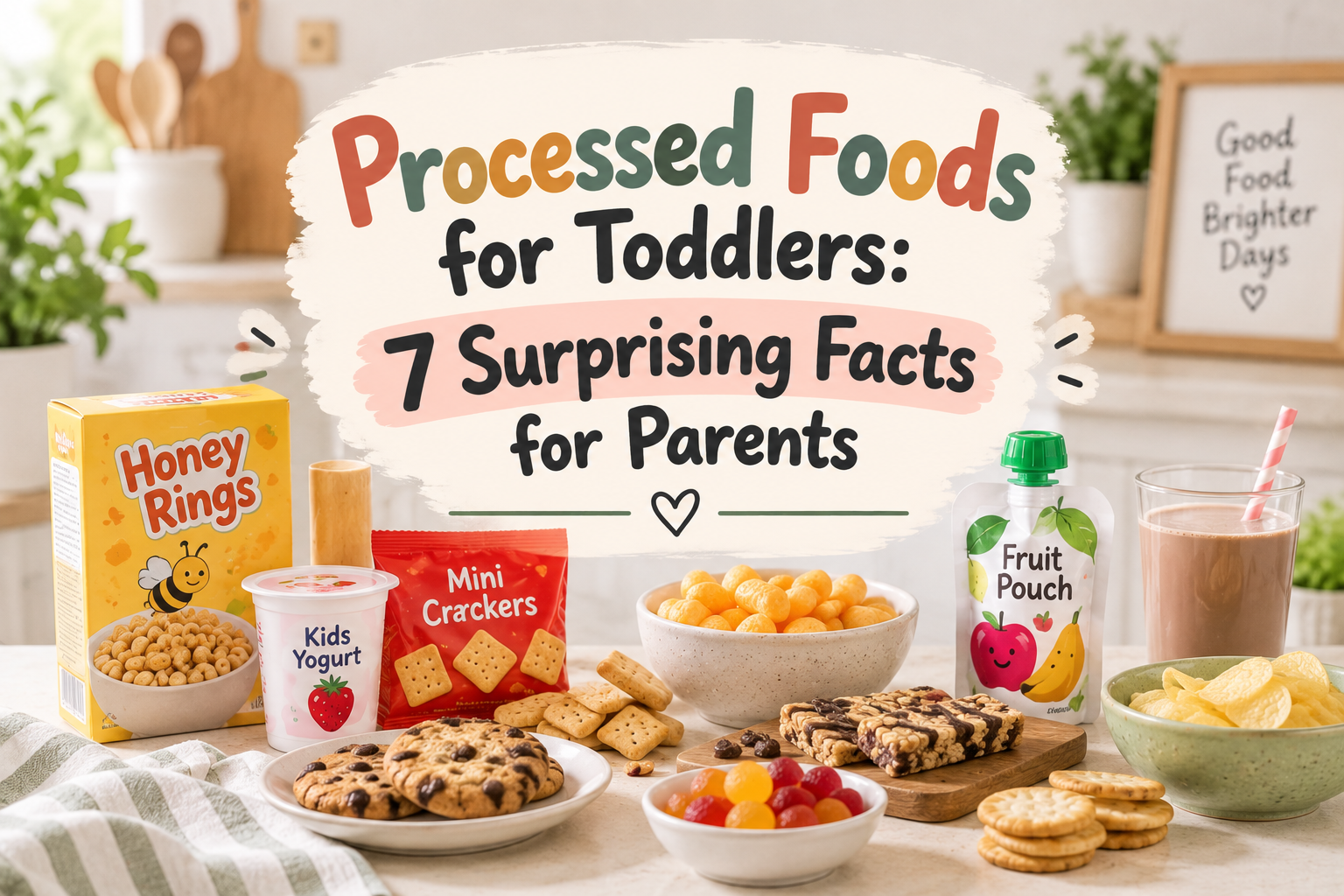
Here are 7 surprising facts about processed foods for toddlers that can make your next trip down the grocery aisle feel a little less overwhelming.

1. “Processed” Doesn’t Automatically Mean “Bad”
Here’s perhaps the most important thing to know: processing is a spectrum.
Many perfectly ordinary foods are processed in some way before they reach your kitchen.
Frozen vegetables have been processed. Plain yogurt is processed. Canned beans are processed. Oats are processed. Cheese is processed. Even pre-cut frozen fruit has gone through processing.
That is very different from assuming that every food sold in a package belongs in the same nutritional category.
The term ultra-processed food is generally used for products that have undergone more extensive industrial processing and may contain ingredients such as flavors, colors, sweeteners, emulsifiers, or other additives.
That distinction matters.
Instead of asking:
“Is this food processed?”
try asking:
“What does this food actually offer my toddler?”
A package of unsweetened frozen berries and a frosted snack cake are both technically processed foods, but they aren’t nutritionally equivalent.
The CDC encourages families to offer young children a variety of nutrient-dense foods and specifically notes that fresh, frozen, and canned fruits and vegetables can all have a place in a child’s diet.
Tiny Tummies Takeaway: Don’t let the word processed scare you away from convenient foods that can still be useful parts of family meals.
2. The Front of the Package Isn’t the Whole Story
Toddler food packaging can be incredibly persuasive.
You’ll see phrases such as:
- “Made with real fruit”
- “Whole grain”
- “Organic”
- “No artificial flavors”
- “Made for toddlers”
- “Naturally flavored”
Those statements may tell you something about the product, but they don’t necessarily tell you everything you want to know.
That’s why one of the simplest habits parents can develop is turning the package around.
The Nutrition Facts label and ingredient list can give you a much clearer picture of what you’re buying.
The CDC recommends using Nutrition Facts labels to compare packaged foods, including their sodium and added sugar content.
You don’t need to become a nutrition detective who spends 20 minutes analyzing every cracker.
Instead, start with a few simple questions:
Is there added sugar?
How much sodium does this contain?
What are the first few ingredients?
Does this food contribute something useful to the snack or meal?
Maybe it provides whole grains. Maybe it contains protein. Maybe it’s simply the convenient crunchy food that helps round out a snack with fruit and yogurt.
Context matters.
A Simple Grocery Store Helper
If reading tiny nutrition labels while keeping a toddler inside a shopping cart sounds nearly impossible, consider keeping a small grocery list or reusable meal-planning notepad in your bag.
Helpful Tool for your planning: Reusable Grocery List / Magnetic Meal Planning Pad*
You can keep a short list of your family’s go-to staples so you’re not reinventing the grocery cart every week.
3. Toddler-Specific Packaging Doesn’t Automatically Make a Food the Best Choice
This one surprises a lot of parents.
A smiling cartoon toddler on the package can make a product feel specifically designed for little bodies.
But “toddler food” doesn’t mean you should stop reading the label.
The CDC notes that some packaged toddler foods can be high in sodium and recommends checking Nutrition Facts labels when choosing products for young children.
That doesn’t mean you need to throw away every toddler snack in your pantry.
It simply means marketing and nutrition are two different things.
Sometimes the simplest option is sitting one shelf away.

For example, depending on your toddler’s age, eating skills, allergies, and individual needs, everyday family staples might include things like:
- plain yogurt
- unsweetened applesauce
- oatmeal
- soft fruit
- low-sodium beans
- eggs
- avocado
- whole-grain toast
- appropriately prepared vegetables
You may discover that you don’t need a special “toddler” version of every food.
And that can sometimes save money, too.

4. Convenience Foods Can Still Have a Place in Real Family Life
This is where I want to remove some of the guilt from the conversation.
Pinterest-perfect snack trays are lovely.
But so is getting everyone fed on a Tuesday.
There will be mornings when breakfast happens later than planned. There will be road trips, daycare pickups, grocery-store meltdowns, sick days, late meetings, and evenings when cooking an elaborate meal simply isn’t happening.
Convenience food can be exactly that:
convenient.
The goal doesn’t have to be creating a kitchen where every cracker, pouch, bar, or frozen food disappears.
A more realistic approach is to think about what you can add.
Serving crackers?
Add sliced strawberries and cheese.
Using a pouch?
Pair it with another age-appropriate food when practical.
Making frozen waffles?
Add fruit and plain yogurt.
Serving a quick pasta dinner?
Add peas or another familiar vegetable on the side.
This simple “what can I add?” mindset can feel much less restrictive than constantly thinking about what you need to remove.
And it helps keep food morally neutral.
A cracker isn’t a parenting failure.
It’s a cracker.
Make Easy Foods Actually Easy
One thing that can help is keeping a few toddler-friendly storage containers ready for grab-and-go snacks.
Make Snack Time a Little Easier
Busy days with a toddler can get messy fast. Reusable divided snack containers make it easy to pack a few favorite foods, keep everything organized, and have snacks ready when little tummies get hungry.
→ Check out these toddler-friendly snack containers on Amazon*
Perfect for daycare, road trips, park days, or simply keeping snack time organized at home.
Prepping a few easy combinations ahead of time can make the convenient choice the choice you already planned.
5. Added Sugar and Sodium Are Worth Checking
You don’t have to obsess over every number on a Nutrition Facts label.
But there are a couple of things that deserve attention when choosing processed foods for toddlers, including added sugar and sodium.
Current CDC guidance recommends avoiding added sugars for infants and young children and limiting foods that are high in sodium. Packaged snacks, processed meats, and some prepared foods can be significant sodium sources.
That doesn’t mean parents need to panic when a child eats a salty cracker at a birthday party.
It means the everyday pattern matters.
If you’re comparing two similar products at the grocery store, the Nutrition Facts panel can help you make a practical choice.
For example:
Yogurt: compare added sugars.
Canned vegetables or beans: look for lower-sodium or no-salt-added options when available.
Snack foods: compare sodium and added sugar between similar products.
Fruit products: check whether sugar has been added rather than assuming “fruit” automatically means unsweetened.
Over time, these tiny decisions can become automatic.
You don’t need the “perfect” product.
You’re simply gathering enough information to make the choice that works best for your family.
6. A Short Ingredient List Isn’t the Only Thing That Matters
You’ve probably heard this advice:
“If you can’t pronounce an ingredient, don’t eat it.”
It sounds simple.
Unfortunately, food isn’t always that simple.
A long ingredient name does not automatically tell you whether a food belongs or doesn’t belong in your family’s diet. Likewise, a product with only a few ingredients isn’t automatically the better choice in every situation.
Instead of turning grocery shopping into a chemistry exam, zoom out.
Look at the food as a whole.
What role does it play in your toddler’s diet?
How frequently do you serve it?
What else does your toddler eat throughout the day or week?
Is there a comparable option with less added sugar or sodium?
Can you pair it with foods such as fruit, vegetables, grains, dairy or dairy alternatives, or another protein source?
This is where balance beats perfection.
The American Academy of Pediatrics has similarly emphasized an overall pattern that focuses more often on whole and minimally processed foods rather than suggesting families must eliminate every ultra-processed option.
That distinction is important because rigid food rules can make feeding young children feel much harder than it needs to be.
Want to Make Label Reading Easier?
If you frequently transfer pantry foods into containers, keeping the original nutrition information nearby can be useful.
→Clear Pantry Storage Containers with Labels*
They’re not necessary for healthy eating—but for families who love an organized pantry, they can make staples easier to see and use before they’re forgotten in the back of a cabinet.
7. Your Toddler’s Overall Eating Pattern Matters More Than One Snack
This may be the most reassuring fact of all. One snack does not define your child’s entire diet. Neither does one birthday party. Or one road trip.
Or that week when your toddler suddenly decided beige was the only acceptable food color. Young children are still learning about food.
The CDC encourages parents to offer children a variety of foods, including fruits, vegetables, grains, proteins, and appropriate dairy or fortified alternatives.
Think of toddler nutrition as a much bigger picture. Instead of examining one snack under a microscope, zoom out and ask:
What does our week generally look like?
Is your child regularly being exposed to different foods?
Are fruits or vegetables offered throughout the week?
Are there opportunities for different textures and flavors?
Are meals generally relaxed rather than filled with pressure?
Those questions can be far more useful than trying to create a perfectly “clean” pantry.
And if your toddler eats a packaged snack while you’re running errands?
That can simply be part of normal family life.
So, Should Parents Avoid Ultra-Processed Foods Completely?

For most families, an all-or-nothing mindset is unlikely to be realistic.
The American Academy of Pediatrics acknowledges that ultra-processed foods are widespread and may be difficult to avoid entirely. Its practical guidance focuses on limiting them when possible while helping children become familiar with whole foods such as fruits and vegetables.
That creates a much more useful goal:
more nourishing choices more often—not perfection every time.
You might keep bananas, yogurt, oats, eggs, frozen vegetables, beans, avocado, or other simple staples around while still keeping crackers in the pantry.
You might cook dinner from scratch one evening and serve a convenient frozen option the next.
You might pack homemade muffins on Monday and grab a packaged snack on Thursday.
That’s real life.
Nutrition doesn’t have to become another impossible standard parents are expected to meet.
A Simple “Pause Before You Buy” Checklist
The next time you’re standing in the toddler snack aisle wondering which box belongs in your cart, try this quick check:
1. What is this food actually giving us?
Convenience counts, but consider its nutritional role too.
2. Does it contain added sugar?
Check the Nutrition Facts panel instead of relying only on front-of-package claims.
3. How does the sodium compare?
If two similar options are available, comparing labels can make choosing easier.
4. Is there a simpler alternative my toddler already likes?
Sometimes there is. Sometimes there isn’t. Both answers are okay.
5. What could I pair with it?
Think fruit, vegetables, yogurt, cheese, eggs, beans, avocado, or another familiar food appropriate for your child.
6. Will my family realistically use it?
A nutritious food that gets thrown away every week isn’t particularly helpful.
7. Am I buying this because it works for us—or because the packaging makes me feel like I should?
That last question can be surprisingly powerful.
What I’d Keep in a Tiny Tummies Snack Station
You don’t need an Instagram-worthy pantry.
A small, predictable collection of foods can make busy days easier.
Depending on your toddler’s age and eating abilities, your household staples might include unsweetened applesauce, oatmeal, yogurt, soft fruits, whole-grain options, low-sodium beans, and other foods your family already enjoys.
Then add a few convenient packaged favorites.
The idea isn’t to create a “good food shelf” and a “bad food shelf.”
It’s simply to make feeding your toddler easier.
Toddler Snack Cup with Spill-Resistant Lid
These products won’t transform your toddler’s nutrition—and they don’t need to. They’re simply tools that can make packing and serving food a little easier.

The Bottom Line on Processed Foods for Toddlers
If there’s one thing to take away from this article, let it be this:
You don’t need a perfect pantry to feed your toddler well.
Processed foods exist on a spectrum, and a package alone doesn’t tell you everything about a food.
Read labels when it’s useful. Pay attention to things like added sugar and sodium. Offer a variety of foods over time. Use convenient foods when they make family life easier.
Most importantly, try not to turn every snack into a judgment about whether you’re doing parenting “right.”
Food is nutrition.
But food is also convenience, culture, celebration, routine, comfort, exploration, and family life.
Your toddler doesn’t need perfection at every meal.
They need opportunities to experience a variety of foods—and parents deserve feeding strategies that actually work in the real world.
Keep Reading on Tiny Tummies
Sources & Further Reading
For current guidance about feeding young children and interpreting packaged foods, see resources from the Centers for Disease Control and Prevention (CDC) and the American Academy of Pediatrics / HealthyChildren.org.
Medical Disclaimer: The information in this article is for general educational and informational purposes only and is not intended to provide medical, nutritional, diagnostic, or treatment advice. Every child is different. If you have questions or concerns about your child’s diet, growth, allergies, feeding development, or nutritional needs, consult your pediatrician or another qualified healthcare professional.
Affiliate Disclosure: This article may contain affiliate links. If you make a purchase through one of these links, I may receive a small commission at no additional cost to you. Affiliate relationships do not change the price you pay. Product suggestions are provided for convenience and are not medical recommendations.
Leave a Reply